CIAFF-UAM (Centro de Investigación Avanzada en Física Fundamental) is an institution within the Universidad Autónoma de Madrid that fosters cutting-edge research and synergies in many areas of Physical Science
Hasta la física y más allá: próxima parada, el futuro
Date
Venue
IFT
Abstract
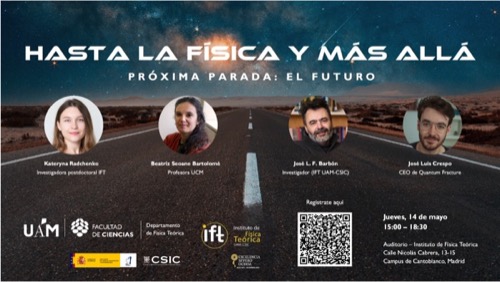
Next Thursday, 14 May,“Hasta la física y más allá: próxima parada, el futuro” will take place: a science outreach event that will bring together students, researchers and science communicators for an afternoon devoted to some of the most fascinating questions in contemporary physics.
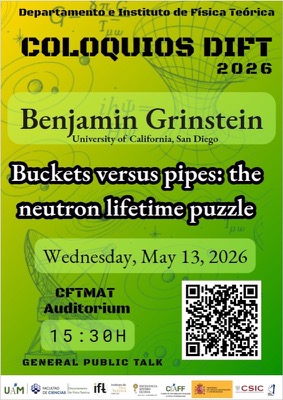
Magnetic Fields Across the Universe: From Primordial Physics to the Cosmic Web
Date
Venue
Sala 201, Module 15
Abstract
Recent astronomical observations have revealed that magnetic fields permeate not only galaxies and clusters, but also the voids and filaments of the cosmic web. The origin of these large-scale magnetic fields remains an open problem, but comparisons with cosmological MHD simulations favour scenarios in which these magnetic fields were produced in the very early Universe. If confirmed, such primordial magnetic fields would offer a unique observational probe of the first microseconds after the Big Bang, potentially connected to physics beyond the Standard Model.
Dr. Santiago Tanco (IFLP-CONICET/UNLP, La Plata, Argentina)
Title
Bayesian tools for the LHC: a proof of concept in di-Higgs searches
Date
Venue
Sala 201, Module 15
Abstract
Extracting reliable information from collider data requires a combination of mathematical, computational and statistical tools to model the observed distributions, often with the help of powerful simulations. But when simulations cannot be fully trusted, data-driven approaches become indispensable. In this talk, I will present probabilistic and Bayesian tools that provide a flexible, data-driven method for unsupervised training on probabilistic models of collider observables, highlighting their advantages for parameter inference and uncertainty estimation.
New (astro)physics in high-energy astronomy and cosmology
Date
Venue
Sala 201, Module 15
Abstract
In the first of the talk I will discuss the phenomenology of cosmic-ray diffusion in the Galaxy and the associated gamma-ray and neutrino emission. The aim is to understand how the combined study of local cosmic-ray spectra and diffuse emissions can help to unveil anomalies that may point towards either non-standard propagation scenarios (and new astrophysical phenomena in general), or new physics (for instance, particle dark matter annihilation/decay).