
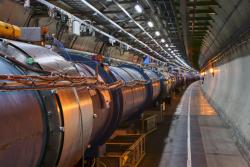
After nearly two decades of operation, the Large Hadron Collider (LHC), located at CERN (Geneva), will conclude data-taking for its current programme at the end of June. Since its launch in 2008, this accelerator has become the most powerful tool ever built for studying the fundamental structure of matter. During this time, the collider has delivered 54 thousand trillion proton-proton collisions to each of the ATLAS and CMS experiments, corresponding to an integrated luminosity of 540 femtobarns — almost double what was envisaged when the machine was designed. In addition, more than 300 billion heavy-ion collisions have been recorded thanks to the LHC.
One of the great achievements of the LHC experiments has been the ability to measure physical phenomena with unprecedented precision, thanks to the development of novel analysis techniques and the processing of enormous volumes of data. The thousands of scientists who make up its collaborations have explored previously uncharted territory in physics, culminating in the historic discovery of the Higgs boson and increasingly precise studies of its properties. The LHC has also driven numerous major scientific advances, including the discovery of more than 85 hadrons — particles composed of quarks —, the imposition of ever-stricter limits on the existence of new particles, investigations into the asymmetry between matter and antimatter, and studies of the nature of the quark-gluon plasma that dominated the first moments of the Universe. The significance of these results has been recognised with some of the world's most prestigious scientific awards, among them the 2013 Nobel Prize in Physics, awarded to François Englert and Peter Higgs following experimental confirmation of the mechanism that bears their names, as well as the Breakthrough Prize in Fundamental Physics, awarded in 2025 to the ALICE, ATLAS, CMS and LHCb collaborations.
The Universidad Autónoma de Madrid (UAM) has played a prominent role in many of these advances. The UAM joined the CMS experiment in 1992, becoming involved from the outset in the design and development of the central muon detector based on drift tubes. Since then, its researchers have contributed to the development of the trigger system, to its upgrade for the future high-luminosity phase (HL-LHC), as well as to detector operation and muon reconstruction. The UAM joined the ATLAS collaboration in 1994, participating in the design, construction and operation of the electromagnetic calorimeter, an essential component for the detection of electrons and photons. The university's researchers have also played a leading role in the commissioning, operation and data quality assessment of this detector. Furthermore, the UAM hosts one of the nodes of the LHC's worldwide computing network — a critical infrastructure for the processing and storage of collected data, as well as for the production of simulations using event generators — serving the entire ATLAS collaboration. Both the ATLAS group and the high-energy physics laboratory housing all the computing infrastructure currently belong to the CIAFF.
The LHC has closed one chapter, but it is far from having delivered its last collisions in the study of the structure of matter. From July onwards, an extensive upgrade programme will begin for both the accelerator and the detectors, with a view to the start, in 2030, of the high-luminosity phase (HL-LHC), in which the number of proton-proton collisions recorded so far is expected to be multiplied tenfold. The HL-LHC will allow elementary particles to be studied with unprecedented precision and, perhaps, reveal new phenomena that will broaden our understanding of the Universe.
